


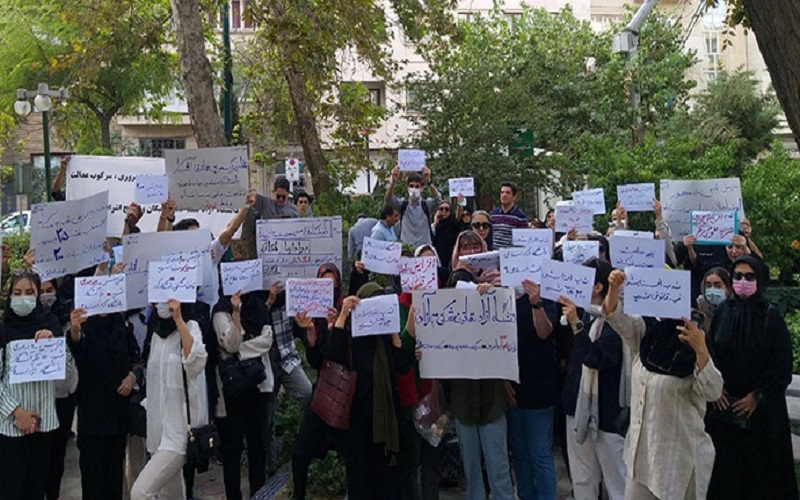

On Tuesday, October 22, Tehran experienced another surge of protests, sparked by widespread opposition to the death penalty and worsening economic conditions. Demonstrations emerged as part of a broader movement against the Iranian regime’s repressive policies, with various groups, including retirees and oil industry workers, joining forces to express their grievances.
Protest Against Death Sentences
A significant demonstration took place in front of Iran’s Parliament, led by the families of prisoners facing execution. This rally coincided with the “No Execution Tuesdays” campaign, a grassroots initiative aimed at abolishing the death penalty in Iran. Protesters chanted slogans like “Do not execute” and carried signs reading “Stop the execution machine – stop the cycle of violence.”
This protest comes in the context of growing public outrage against the regime’s use of capital punishment as a tool of repression. Families of death row inmates called for an end to the inhumane practice, demanding justice and the protection of human rights.
Retirees Protest Economic Hardship
In addition to the protests against executions, retirees, particularly cultural pensioners, demonstrated in front of the National Pension Fund. Many voiced their frustration over their deteriorating financial situation, which they attribute to government corruption and mismanagement. One protester passionately confronted a government official, saying, “You must be responsible for 48,000 families who are suffering. You’ve never known the shame of being unable to provide for your family.”
Another retiree lamented, “My daughter is of marriageable age, and I can’t afford to help her get married. You must be held accountable.” These cries represent the broader discontent of thousands of families who feel their livelihoods have been sacrificed to fund the regime’s proxy wars in the region.
Similar protests by retirees occurred in Kermanshah, where demonstrators chanted, “The government betrays, the parliament supports,” highlighting a growing sense of betrayal among the population. The gathering in Kermanshah took place outside the provincial National Pension Fund office.
Oil Workers’ Protests in Ahvaz and Mahshahr
Meanwhile, oil industry workers in Ahvaz staged a protest against the Ministry of Oil for failing to implement a parliamentary resolution addressing their grievances. Holding placards, the workers called attention to the unfair treatment they’ve endured, despite their critical role in producing 80% of the country’s oil and gas. Their protest centered on Article 10, a provision meant to protect their rights, which they claim has been ignored.
In Mahshahr, employees of the Petrochemical Research and Technology Company echoed the demands of the Ahvaz workers, protesting outside the company’s headquarters. They decried the Ministry of Oil’s negligence and demanded the proper implementation of their legal rights.
Gas Refinery Workers Join the Protest Movement
Workers at the Parsian Gas Refinery in Mehr, Fars Province, also joined the growing protest movement, aligning with South Pars oil workers, who have been protesting for five consecutive weeks. Their demands include the reinstatement of a dismissed workers’ representative, proper implementation of paid leave agreements, fair compensation for contracted drivers, and equal work-rest cycles for all employees. These issues have long plagued the refinery workers, who accuse the government of failing to honor previous agreements.
Large-Scale Protests in Asaluyeh and Khark
Asaluyeh’s oil workers organized a large-scale rally, protesting wages that fall below half the poverty line, which is estimated at 35 million tomans. Their calls for fair pay and improved working conditions have so far gone unanswered by the government.
Similarly, employees on Khark Island, located in the Persian Gulf, protested the partial payment of their salaries. Displaying their demands on large placards, they called on the government to address their ongoing wage issues.
Commemoration of Ramin Fatehi
In Sanandaj, a ceremony was held to mark the second anniversary of the death of Ramin Fatehi, a 48-year-old protester who was killed under torture by regime forces following his arrest during the 2022 protests. Fatehi’s family and supporters gathered at his grave, honoring his memory in a somber but defiant display of resistance. His death has become a symbol of the struggle for justice and freedom in Iran, embodying the resilience of the Iranian people against state oppression.
Conclusion
The protests in Iran on October 22 reflect a society grappling with both political repression and economic hardship. While the regime continues to suppress dissent with violence and executions, these demonstrations highlight the growing resolve among various segments of society—workers, retirees, and families of prisoners—to demand change. The protests, though diverse in their specific grievances, share a common thread of opposition to a regime that many feel has betrayed its people.